Monday, July 8, 2013

The writer goes to the office - and stays home

Like many writers, I work from home. And I love it.

But that's not the case for everyone who follows the home-office path. A recent article in The Globe and Mail explores the challenges faced by those of us who find the lure of the non-commute appealing.

There are pitfalls, of course, as this article outlines:

Considering a home office? Take my advice

For many, it's the lure of the couch, the appeal of not having to change out of pyjamas, the proximity of the kitchen.

For others, the home office is a disaster: too lonely, too many distractions, too unproductive.

This is what I love about working at home:

1. My turf, my rules. I can make tea when I want. I can work anywhere I want. I'm the boss when it comes to time management. Flexibility. Freedom!

2. My own sounds. I have an inconvenient sensitivity to sounds. In a previous job, I worked in Cubicle Land, and it was hell. Too many overheard phone conversations, too much chatter, too much crappy radio blather from that one guy who just had to have CoolMusic 105 playing in the background. Kill me now! I do have a dog that barks rather too much, but other than that, I can control the sounds (or lack thereof) in my workspace.

3. I am a very disciplined worker, so productivity is not an issue. And even when the siren call of Facebook or Twitter or email calls, I indulge, and then I get back to work. My work patterns were often disrupted in previous work environments outside my home - mostly by other people. Go away! I'm working!

One of my workspaces:

My daughter moved out and I quickly took over her room. It's nice
to have a room with a door that closes, especially for
conference calls, or when I need to remove myself from the sounds
of the noisy world around me.

Another of my workspaces:


Sometimes, especially in winter, I move everything to this wonderful
desk in the living room. It's warm there, and the windows
let in the best light. It's a bit out in the open, so it has
to be a day when others are out and the house is quiet.


And then there's this one:

Close to the kitchen (kettle & tea), with the cryptic in safe
proximity on the counter behind my chair (for breaks).
The dog likes it too ("Let me out!" "Let me in!" and repeat....)

And this one, perhaps my favourite:

Not going to lie - it's pretty sweet to work out
under the gazebo on a warm summer day...

Yup. Working at home works for me.


Tuesday, July 2, 2013

Facts & Arguments revisited: Writing for free?

I continue to be amazed at the number of hits this blog gets thanks to a piece I posted in 2010 (yes, three years ago!) about The Globe and Mail's Facts & Arguments essays, for which the writers are not paid. It's a tired topic, but every time I think it's finally dropped off the horizon, there's a flurry of hits that show up in my statistics and leave me shaking my head.

Here's a link to that post: Facts & Arguments: Why I can't send my essays to The Globe and Mail, and why you shouldn't either

It's a hot issue for writers - not being paid. The F&A situation is particularly disappointing because there was a time, pre-2009, that the essay writers were paid: $100 for each 800-word essay. But, for whatever reason, the editorial decision-makers changed their policy (a cost-cutting measure?) and turned the F&A page into a freebie.

Some of the essays that get published are terrific. Some of them aren't. Too many fall into the "me, me, me" category, and quite a few can be filed in the "dead relative" department. Some are so badly visioned and written that I wonder how they made the cut.

But then, I'm a professional writer who writes for a living. Just like Margaret Wente, and Ian Brown, and Peter Cheney and Roy McGregor and Sarah Hampson, and any number of other writers whose work appears on the pages of the Globe and Mail. I suspect many of the essayists who see their work on the F&A page are not.

Perhaps these contributors work in professions where not getting paid for their services is acceptable. Writing personal essays is just a hobby, after all, right?

The Globe's stance appears to be that contributors should feel it's reward enough just to see their essay in The Globe, read from coast to coast. Sorry, but that sounds like arrogance to me. And here's the kicker: the writer isn't paid, but the illustrator is.

I'd love to contribute my writing to The Globe, just like all the other professional writers who make it one of the best reads in Canada.

But shouldn't I be paid, too?

Monday, June 24, 2013

Grammar Wall of Shame #3: Their

This flyer came in the mail last week:

Oh, Rogers! You're ONE of a kind. Get it?
It's the wrong use of that dreaded their again. And don't try to tell me it's a case of Rogers trying to be gender-neutral; gender has nothing to do with it. You wouldn't say Rogers gives his or her customers the freedom... would you?

In this case, Rogers is the name of one organization, just like Tim Hortons, McDonalds or Sears. In grammar terms, Rogers is considered singular and requires a singular verb and singular pronoun reference.

Top marks on the singular verb: Rogers gives. Just like: he gives, she gives, it gives. Singular subject takes a singular verb.

So why did the writer suddenly decide to use a plural possessive pronoun reference?

The correct sentence is:

Only Rogers gives its customers the freedom to do more.

There's only one Rogers, and it's headed for the Wall of Shame!


Wednesday, June 19, 2013

Give me back my apostrophes, please!


The interviews featured grammarians, editors and language experts from Canada, the UK, the United States and Australia, and the conversations were lively and entertaining.

But I confess, the whole idea of messing with punctuation fills me with (gulp!) horror.

The power of punctuation!
Teaching punctuation to college students – most of them in business programs – remains one of the highlights of my college teaching career. Students tend to approach the topic of punctuation with misconceptions and a fair amount of resistance.

To give them credit, however, my students – most of them under the age of 25, members of the text-speak generation – always indicated that they could see the difference between “real” written communication for the workplace, and the informal grammar-challenged shorthand used on their mobile devices. They understood that formal and informal workplace communication necessarily has certain conventions and expectations, punctuation among them. But the nit-pickiness of it disturbed them.

“Who cares if a comma is missing?” “What’s the point of using a semi-colon? What IS a semi-colon, anyway?” And my favourite: “Everybody knows what I mean, so what’s the big deal?”

This is the argument put forward by Ted Gibson, a professor of cognitive science at MIT, one of the CBC interviewees: that the context of any written passage will make it clear whether you’re talking about an item commonly found on a beach, or a female who will be doing something: shell, she’ll.

His point was that in spoken English, we understand each other, so it’s not a huge leap to expect people to clue into the meaning behind written English, apostrophes present or not. “His brother’s keeper” or “his brothers keeper” – the reader will figure it out without the little swirl cluttering up the page.

Give me swirls and clutter. Just because there are so many rules concerning correct punctuation doesn’t mean that we should jettison those qualifying, clarifying, stylizing squiggles, swirls, dots and dashes. Clutter, my Aunt Fanny!

No, I believe punctuation – even pesky apostrophes – helps corral English usage, which could easily go madly off in all directions (just ask someone who is learning English as a second language.)

Punctuation is a tool that helps writers communicate with style and, most importantly, clarity. It helps readers understand, too. (Does the million-dollar comma fiasco ring a bell?)

Give me my apostrophes (and commas, and semi-colons and the whole squiggly lot), please. They’re some of the sharpest tools in my writing toolbox. 

I rest my case!


Wednesday, June 12, 2013

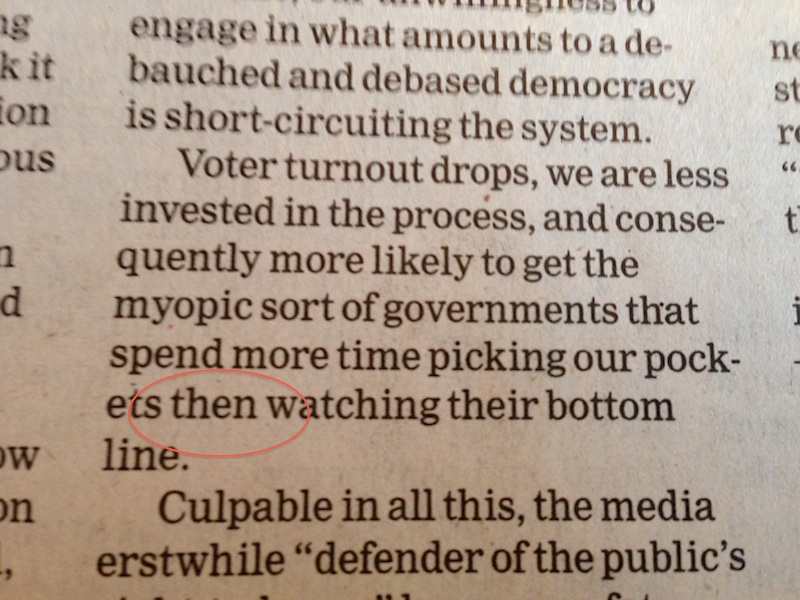
Grammar Wall of Shame #2: Then and Than

Perhaps it's because the two words sound similar when spoken.

Perhaps it's because some writers don't proofread for the correct usage of adverbs, conjunctions and prepositions.

In any case, one letter does make a big difference, especially when using then and than.

As in:

Oops.
Then is an adverb, meaning at that time, or after, or also, or therefore.

So I suppose this writer could have meant to say:

Voter turnout drops, we are less invested in the process, and consequently more likely to get the myopic sort of governments that spend more time picking our pockets and after that watching their bottom line.

First the government picks our pockets, and then it watches its bottom line?

Nope, don't think so.

The appropriate word in this example is than, the conjunction that is used in a comparison:

...more time doing this than doing this...

Sadly, this award-winning writer was putting forward a strong argument - until she hit the Wall of Shame.


Monday, June 10, 2013

Writing Magic: First you have to plant some seeds...

Raise your hand if sometimes your writing life stumbles. You decide to clean your desk - or your office, or your whole house - instead of focusing on the creative process. You let the distractions take over. You are overwhelmed by Life (okay, this really does happen, so I'll cut you some slack here.)

Domestic chores don't get done unless someone does them. Journeys don't get completed unless the traveller gets in the car (boards the train/plane, takes that first step, etc). Flowers don't grow unless someone puts a seed in the soil.

Yes - let's go with that one.

Imagine these are your creations:


They're your characters, scenes, stories, novels, poems, plays, whatever.

Gorgeous, rich, tall, full of life, right?

Well, they didn't happen by magic. 

They started out as little black seeds in a packet. Lifeless. Dry. 

Waiting.

But put them in the soil, give them some water, and one day you'll see these:


My point? 

The writing life doesn't happen by magic. 

Here's the secret: If you want your creativity to grow, you have to plant the seeds. Now. Don't put roadblocks in your own way. I mean, really, how hard is it to pick up the packet, rip it open, tip out the little, black, dormant seeds and push them into the soil?

Whatever metaphor you want to use is just fine - putting seeds in the soil, taking that first step on a journey, or (as Louis L'Amour wrote), turning on the faucet to get the water flowing - it all amounts to the same concept.

Get started. Now.

It's not magic, it's just one more truth in the writing life, and this from a writer (moi!) who has a championship history of putting roadblocks in her own way. Seeing those little sprouts in my garden this morning, and thinking back to the towering, gorgeous sunflowers I enjoyed as last summer crept to a close, I gave myself a mental shake.

It all starts somewhere. Seat of the pants in the seat of the chair, etc. 

But first you have to plant some seeds.

Need some help with finding the seed packet? Here are some writing starters from author and teacher Heather Wright.


Monday, June 3, 2013

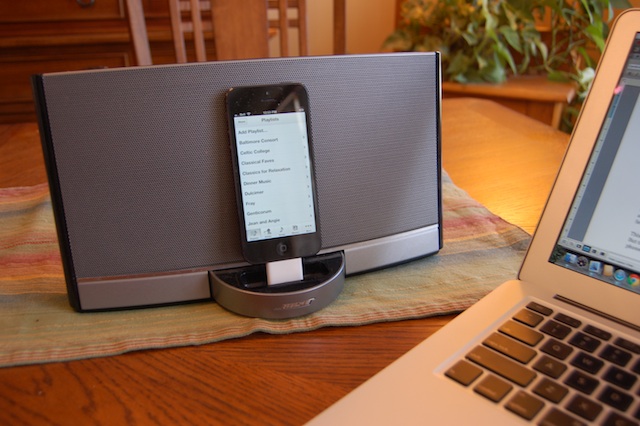
What's your musical soundtrack?

Writing to music? Or to silence? 

When my husband was writing his recently published book, The IT Chauffeurhe spent nearly a year in his downstairs office wrestling with those things that all writers wrestle with: finding the right words to tell his story.

He was very disciplined about his work, something I admired, making a schedule for himself and sticking to it, day in, day out. Researching the issues, churning out the pages, and handing them over to me for editing.

I know this process well, of course, because I’m a writer too. But there was one thing that drove me crazy: whenever I had to visit his office, I found him hard at work to the accompaniment of his favourite rock radio station.

This station plays current pop and rock favourites, so there’s quite a bit of music. But there are also blaring advertisements, snappy announcers, and fair amount of phone-in contests and generally (what I think are) annoying audio garbage.

This is the soundtrack he wrote to every day.

How?

I have writing friends who listen to jazz or classical music, to music-only radio stations, or to specially selected playlists when they’re working. Friends who write in coffee shops, immersed in a soup of sound.

But me? It has to be quiet – or at least such a wall of sound that it all blends together and becomes a backdrop.

Some writers need music. A recent podcast on CBC’s The Next Chapter featured a “smackdown” – a sort of debate – between two writers discussing their own need for no music or a playlist. I sided with Cathy Marie Buchanan, who said “No music!”

The other view, put forth by writer Andrew Kaufman, suggests that a musical sountrack helps writing by creating a mood and prompting emotional responses. (You can read their arguments on the CBC Books/Canada Writes page, here.)

Nope. Turn off that radio. Silence the playlist. Keep your driveway basketballs and lively café conversation away, please.

When I’m writing, all I want to hear are the words in my head travelling magically to the page.

But that’s just me…